
Lombalgie : potentiel du changement
26 October 2025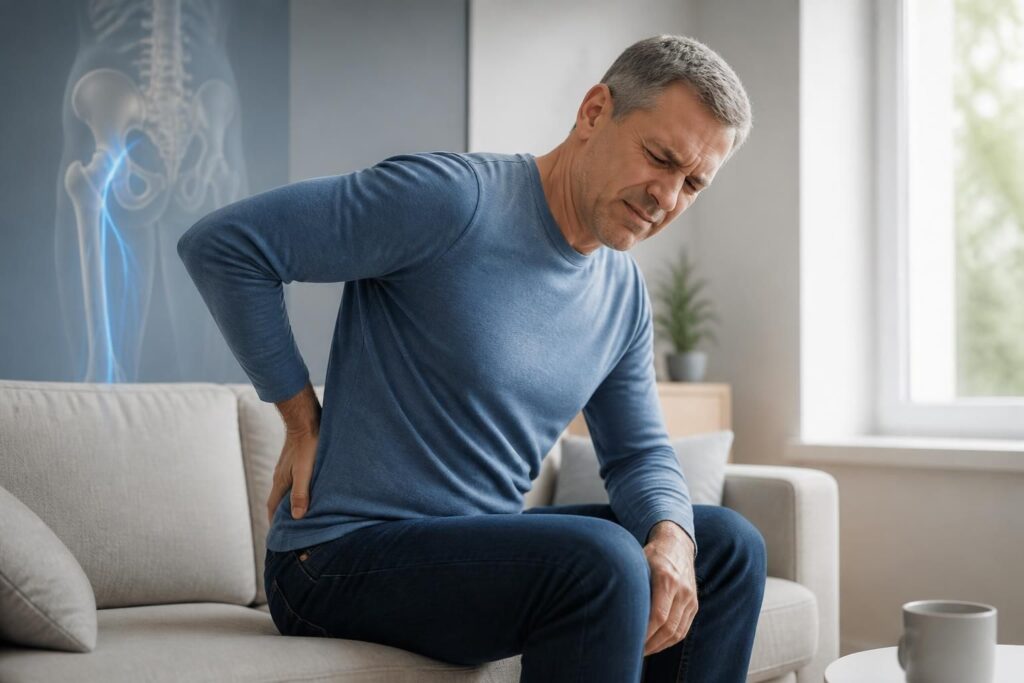
English adaptation of the original French article.
SCIATICA · SYMPTOMS AND CONSULTATION
Understand the path of sciatic pain, recognize the associated symptoms and prepare the information to discuss during a consultation.
Explore the symptoms · Prepare for a consultation · Treatment options
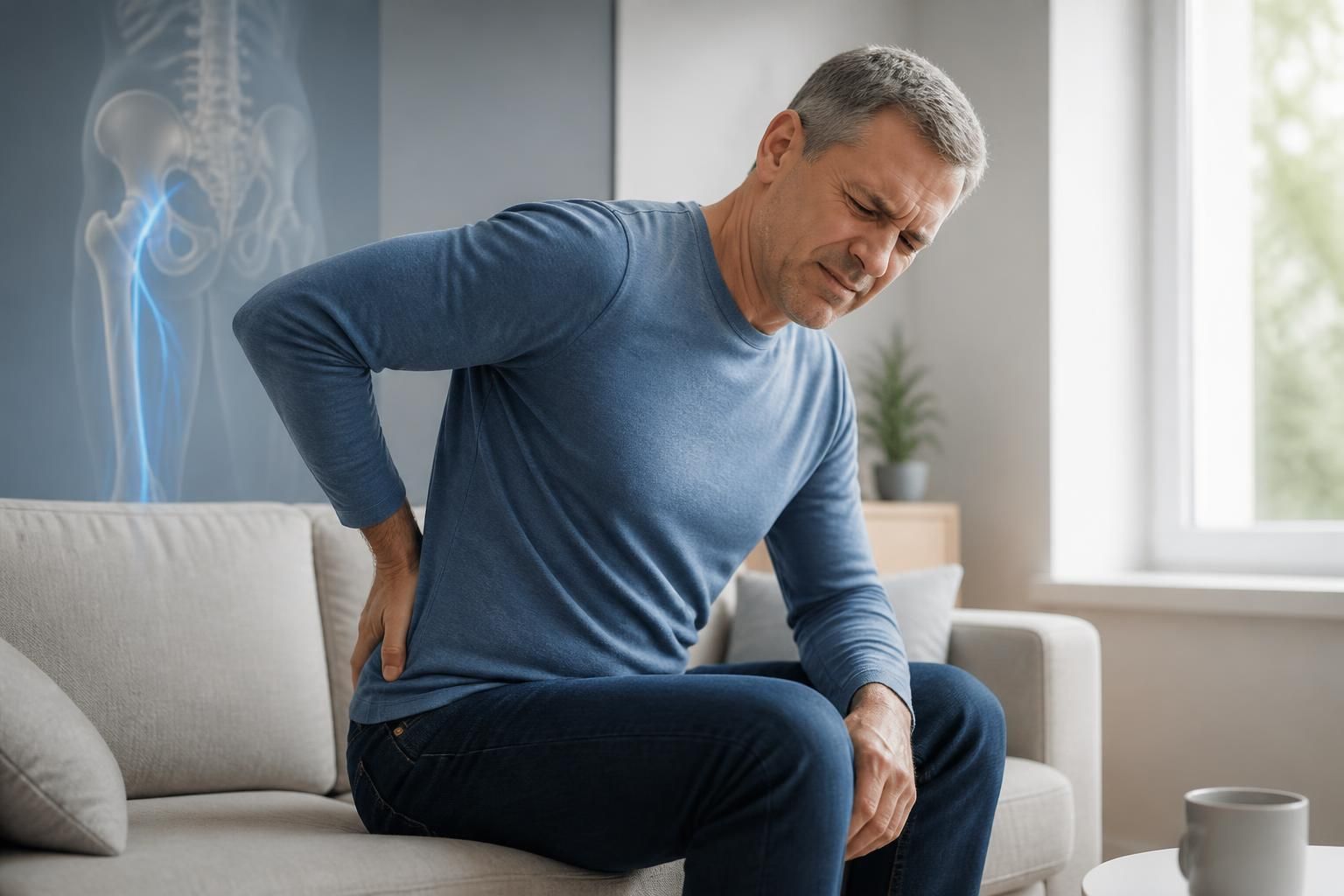
Sciatic pain is a common condition affecting several million people in France, disrupting daily life through symptoms that can be intense and disabling. The pain follows the path of the sciatic nerve, extending from the lower back into the leg and sometimes as far as the foot. Although it can occur at any age, it is particularly common among people aged 30 to 50. In 2026, understanding the symptoms of sciatica helps people obtain timely care and avoid potentially serious complications. A clearer understanding also supports strategies to manage everyday pain and prevent recurrence.
Sciatica is not a disease in itself. It is a sign of irritation or compression of the sciatic nerve, often related to a lumbar herniated disc or other causes such as piriformis syndrome or osteoarthritis. Symptoms can include burning pain, sharp shooting sensations or tingling, accompanied by changes in movement or sensation. Distinguishing sciatic pain from ordinary lower back pain helps guide treatment according to the specific symptoms. Recent therapeutic developments in 2025 and telemedicine tools have expanded care pathways, combining an initial remote assessment with in-person follow-up according to severity.
Prevention also plays a role, including specific exercises and appropriate postural habits at home and at work. This guide examines characteristic symptoms, warning signs, common causes and available treatments, together with practical information about when to consult a healthcare professional.
Key points
- Sciatic pain follows the sciatic nerve pathway from the lower back into the leg, with symptoms that vary according to the nerve root involved.
- Common causes include a herniated disc, piriformis syndrome, lumbar osteoarthritis and certain spinal injuries.
- Recognizing the symptoms helps distinguish sciatic pain from lower back pain without nerve-related symptoms.
- Warning signs requiring urgent medical assessment include bladder or bowel problems, paralysis, or intense persistent pain with fever.
- Treatment may combine medication, physiotherapy, adapted exercise, injections and sometimes surgery when complications occur.
- Preventive measures include regular appropriate exercise, posture and ergonomics, and careful lifting techniques.
Sciatica symptoms: recognizing characteristic sciatic pain
Recognizing the symptoms is the first step in guiding care. Sciatic pain has a characteristic radiating pattern: it starts in the lumbar spine, crosses the buttock, travels down the back of the thigh and calf, and may reach the sole of the foot.
People describe a variety of sensations, including burning, stabbing pain and sudden electric-shock-like pain. This variety reflects the neuropathic nature of pain associated with irritation or compression of the sciatic nerve.
Symptoms vary with the nerve root involved. Pain associated with the L5 root tends to follow the outer buttock, the outside of the thigh and the top of the foot. It may be accompanied by weakness when lifting the foot. S1 involvement can cause pain through the buttock, back of the thigh, calf and sole of the foot, sometimes with a reduced Achilles tendon reflex.
Other symptoms include pins and needles, tingling or numbness, mainly in the leg or foot. Muscle weakness may occur and can make walking on the heels or toes impossible.
Coughing, sneezing and prolonged sitting can increase sciatic pain. This is related to increased pressure around a compressed nerve root. Unlike lower back pain limited to the lumbar region, sciatica is characterized by pain radiating into the lower limb.
| Nerve root | Main pain distribution | Associated symptoms |
|---|---|---|
| L5 | Outer buttock, outer thigh and top of the foot | Burning, tingling and weakness when lifting the foot |
| S1 | Buttock, back of the thigh, calf and sole of the foot | Shooting pain and reduced Achilles tendon reflex |
Recognizing these patterns helps professionals distinguish sciatic pain from other causes of back pain or neurological symptoms and select additional examinations and treatment.
Medical consultation: when and why to seek advice for sciatic pain

A medical consultation is appropriate when sciatic pain develops, particularly if symptoms persist or worsen. A family physician is often the first point of contact and can assess the situation, prescribe treatment and refer to a specialist when necessary.
A routine consultation may be sufficient for a first episode of moderate pain with limited disability. In 2026, teleconsultation can provide an initial remote assessment of pain intensity, distribution and aggravating factors. It does not replace a complete physical examination to assess reflexes, muscle strength and specific tests such as the straight-leg raise test.
Certain signs call for urgent in-person assessment or emergency care:
- Bladder or bowel dysfunction, including urinary or faecal incontinence or difficulty urinating.
- Paralysis of a lower limb, significant muscle weakness or inability to walk.
- Numbness around the genitals or the saddle area.
- Intense pain that does not respond to usual treatment and is accompanied by fever.
These symptoms may indicate cauda equina syndrome or a spinal infection. Prompt care is needed to reduce the risk of lasting consequences.
To prepare for a consultation, gather the following information:
- A precise description of the symptoms: location, type of pain and intensity on a scale from 0 to 10.
- How long symptoms have been present and how they have changed.
- Treatments already tried, including medication, physiotherapy and other care.
- Relevant medical history, including a previous herniated disc, osteoarthritis or spinal surgery.
- Recent test results, when available, such as MRI, X-rays or electromyography.
Preparation helps make the consultation more effective and supports development of an appropriate treatment plan.
Common causes of sciatica: understanding the source of the symptoms
Sciatic pain originates from irritation or compression of the sciatic nerve or its nerve roots in the lower back. Several causes may be involved, with some occurring more often than others.
A lumbar herniated disc remains the most common cause, accounting for approximately 70–80% of cases. It occurs when an intervertebral disc develops a fissure and some of its gel-like centre extends outward against a nerve root, producing the characteristic pain.
Piriformis syndrome is a muscular cause. The piriformis muscle, located in the pelvic region, can compress the sciatic nerve when it is in spasm or inflamed. This can produce sciatic-type pain without a herniated disc. The approach differs and may include targeted physiotherapy and stretching.
Lumbar osteoarthritis can contribute to narrowing of the spinal canal and persistent compression of nerve roots. This is more common among older adults, although it may occur earlier.
Other factors include spinal injuries, vertebral compression fractures, particularly in people with osteoporosis, and some rare tumours. Assessment of medical history and appropriate imaging help identify the cause and guide the care plan.
| Cause | Description | Initial approach |
|---|---|---|
| Herniated disc | A nerve root is compressed by disc material extending beyond its usual boundaries. | NSAIDs, physiotherapy and strengthening exercises |
| Piriformis syndrome | Piriformis muscle spasm compresses the sciatic nerve. | Stretching, physiotherapy and osteopathy |
| Lumbar osteoarthritis | Narrowing of the lumbar canal with chronic nerve compression | Medication, adapted exercise and specialized assessment |
| Spinal injury | A fracture or vertebral compression causes nerve compression. | Specialist assessment and, in some cases, surgery |
Sciatica treatment: approaches to pain relief and mobility

For consultation information at TAGMED, choose the page for your preferred clinic: Treatment for sciatica in Montreal or Treatment for sciatica in Terrebonne.
Sciatica care uses a multimodal approach to support improvement in symptoms and a return to everyday activities.
Initial care often includes medication, such as non-steroidal anti-inflammatory drugs, including ibuprofen or diclofenac, and pain medicines such as acetaminophen. Prolonged bed rest is no longer recommended. Adapted activity is preferable to help maintain circulation and reduce stiffness.
Physiotherapy has an important role. Exercises may include targeted stretching, back and abdominal strengthening, and postural work. Examples include pelvic tilts and gentle spinal movements aimed at improving lumbar stability.
In some cases, epidural corticosteroid injections are used to reduce inflammation around nerve roots, particularly when medication alone is insufficient.
Surgery is generally reserved for more severe cases. It can involve removing the portion of a disc responsible for compression or releasing the affected nerve root. It offers a high success rate and noticeable improvement in symptoms.
Modern care also includes developments such as extended-release SP-102 and other targeted treatments undergoing clinical evaluation for persistent pain that has not responded to usual care.
Measures intended to support quality of life and reduce recurrence include:
- Maintaining appropriate regular physical activity.
- Using suitable ergonomics at home and at work.
- Using appropriate lifting techniques.
- Paying attention to sitting and standing posture.
- Performing regular adapted exercises to support the spine.
People in Montreal and elsewhere in Canada can consult services offering an individualized assessment and discussion of treatment options. The local TAGMED guides linked above explain the consultation pathways in Montreal and Terrebonne.
Frequently asked questions
Can sciatic pain resolve completely?
Yes. Approximately 80–90% of people recover within weeks to months after symptoms begin, often without surgery.
Should all physical activity stop during an episode of sciatica?
No. Adapted activity, such as walking or swimming, is recommended to support recovery and reduce stiffness.
When is urgent assessment needed?
Urgent assessment is needed for bladder or bowel dysfunction, progressive paralysis, loss of sensation around the perineum, or intense pain with fever.
What treatments are available for persistent sciatic pain?
Options include physiotherapy, anti-inflammatory medication, epidural injections and, in selected cases, surgery.
Can recurrence be prevented?
Yes. Specific adapted exercise, appropriate posture and careful lifting techniques are preventive measures.
French version and accompanying videos
- Original French article: available through the language switcher above
- First video cited in the original article
- Second video cited in the original article
FAQ
Décompression neurovertébrale
Qu’est-ce que la décompression neurovertébrale?
La décompression neurovertébrale est une thérapie non chirurgicale visant à réduire la pression sur les disques intervertébraux et les nerfs pour soulager la douleur.
Quels types de douleurs la décompression discale peut-elle soulager?
Elle peut soulager les douleurs cervicales, lombaires et les douleurs irradiantes.
La décompression neurovertébrale peut-elle traiter les douleurs chroniques?
Oui, elle est particulièrement efficace pour les douleurs chroniques causées par des affections vertébrales.
Quels sont les avantages à long terme de la décompression vertébrale?
Les avantages incluent une réduction durable de la douleur et une meilleure santé de la colonne vertébrale.
La décompression discale est-elle adaptée aux personnes ayant des implants dans la colonne?
Cela dépend des implants; une évaluation par un professionnel de santé est nécessaire pour déterminer l’adaptabilité.
Quels sont les bienfaits immédiats d’une séance de décompression neurovertébrale?
Un soulagement de la douleur et une sensation de relaxation sont souvent rapportés après une séance.
Combien de temps faut-il pour observer des résultats avec la décompression neurovertébrale?
Certains patients constatent une amélioration dès les premières séances, tandis que d’autres nécessitent plusieurs semaines de traitement.
La décompression discale est-elle reconnue par les professionnels de santé?
Oui, elle est reconnue comme une méthode efficace pour traiter les affections de la colonne vertébrale.
Combien coûte un traitement complet de décompression neurovertébrale?
Le coût varie selon la clinique et la durée du traitement, mais il reste souvent moins cher qu’une chirurgie.
La décompression vertébrale peut-elle améliorer la qualité de vie?
Oui, en soulageant la douleur chronique, elle permet aux patients de retrouver une meilleure qualité de vie et des activités normales.
La décompression neurovertébrale peut-elle éviter une chirurgie?
Oui, pour de nombreux patients, elle offre une alternative non chirurgicale efficace.
Quels sont les symptômes qui nécessitent une consultation pour la décompression neurovertébrale?
Des douleurs persistantes, des engourdissements, des picotements ou une perte de mobilité sont des symptômes qui justifient une consultation.
En quoi consiste la décompression vertébrale?
Elle consiste à étirer doucement la colonne vertébrale pour créer une pression négative, permettant au disque de se repositionner et de réduire les compressions nerveuses.
Quels sont les bienfaits pour les sportifs utilisant la décompression neurovertébrale?
Elle aide à réduire la douleur et à accélérer la récupération après une blessure liée à la colonne.
Quels sont les risques de la décompression neurovertébrale?
Les risques sont faibles, mais certains patients peuvent ressentir une légère raideur temporaire après les séances.
Combien de temps dure une séance de décompression discale?
Chaque séance dure généralement entre 15 et 30 minutes, selon le protocole personnalisé.
Quels types de douleurs sont soulagées par la décompression discale?
Elle soulage les douleurs lombaires, cervicales et irradiantes causées par des compressions nerveuses ou des disques endommagés.
La décompression vertébrale peut-elle traiter plusieurs niveaux de disques en même temps?
Oui, le traitement peut être ajusté pour cibler plusieurs niveaux de la colonne vertébrale en fonction des besoins du patient.
Puis-je pratiquer des activités sportives pendant le traitement?
Oui, mais il est important de consulter un professionnel pour adapter les activités selon votre condition.
Quels sont les signes indiquant que la décompression neurovertébrale est efficace?
Les signes incluent une réduction de la douleur, une amélioration de la mobilité et une diminution des symptômes neurologiques comme les engourdissements.
Références