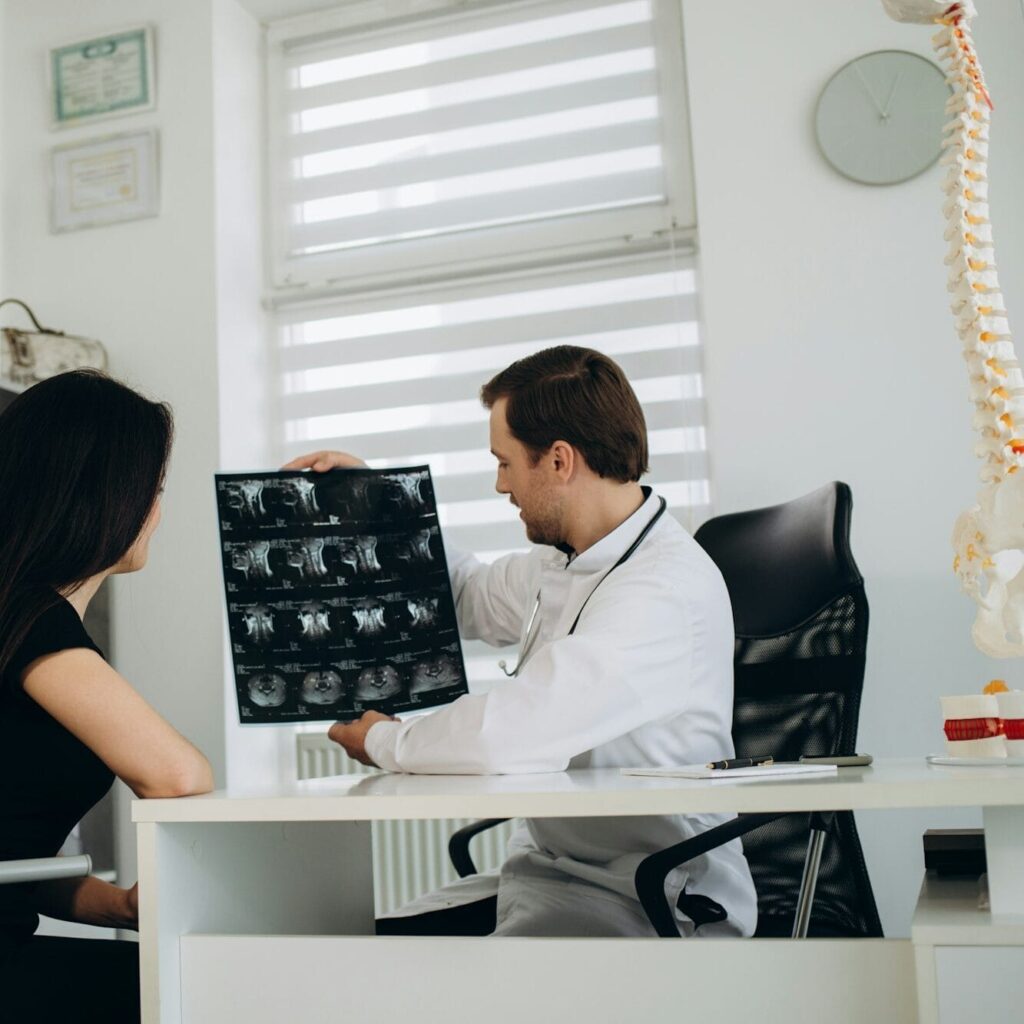
Female patient examining spine at physiotherapist at vertebrology center
Introduction
Sciatica, commonly referred to as sciatica, is a pain that radiates along the sciatic nerve, extending from the lower back, through the buttocks, and down into the legs. This painful condition affects many people, disrupting their daily lives and their ability to lead an active life. Fortunately, neurovertebral decompression offers a glimmer of hope for those seeking relief without resorting to invasive interventions. This article explores in depth how this method can alleviate sciatica, focusing on how it works, its benefits, and testimonials from patients who have regained a pain-free life.
Understanding Sciatica
Sciatica is often the result of a herniated disc, spinal stenosis, or spondylolisthesis, where pressure on the sciatic nerve causes intense pain, numbness, or tingling along its path. Traditional treatments include medication, physical therapy, and in some cases, surgery. However, these options do not suit everyone and may have undesirable side effects or simply provide temporary relief.
The Principle of Neurovertebral Decompression
Neurovertebral decompression is a non-surgical therapy that uses a specialized table to gently stretch the spine, creating a vacuum that can allow herniated discs to reposition and reduce pressure on the sciatic nerve. This process also promotes an optimal healing environment for damaged discs by improving the circulation of fluids, nutrients, and oxygen in the affected area.
Benefits of Decompression for Sciatica
Pain Reduction: Many patients report a significant decrease in their pain as early as the first decompression sessions.
Improvement in Mobility: By reducing pressure on the sciatic nerve, patients regain better mobility and can resume their daily activities without pain.
Non-Invasive Alternative: This method offers a treatment option without the risks associated with surgery or the side effects of medications.
The Scientific Foundations of Neurovertebral Decompression
To fully appreciate how neurovertebral decompression can relieve sciatica, it is crucial to understand the scientific foundations underlying this method. Decompression works by applying a controlled traction force to the spine, which decreases the pressure inside the intervertebral discs. This reduction in pressure creates a suction effect, helping herniated or bulging discs return to their normal position and relieving the sciatic nerve from any compression. This process also helps stimulate blood flow to the affected area, accelerating the transport of essential nutrients necessary for the healing of damaged tissues.
Patient Testimonials: Regaining Mobility and Quality of Life
Marie, 54, suffered from sciatica for several years, with pain radiating from her lower back to her right leg, severely limiting her mobility and ability to perform daily tasks. After trying various treatments without success, she was referred to neurovertebral decompression. « From the very first sessions, I felt considerable relief. The pain began to fade, and I gradually regained the ability to walk without pain, » shares Marie. Her story is not unique; many patients report similar improvements, testifying to the effectiveness of this approach in treating sciatica.
Why Choose Neurovertebral Decompression?
Neurovertebral decompression stands out as a particularly appealing treatment option for several reasons:
Safety: As a non-invasive method, it presents minimal risk compared to surgery, avoiding potential complications related to surgical interventions and anesthesia.
Effectiveness: It directly targets the cause of sciatica, providing lasting relief instead of merely masking the pain.
Comfort: The treatment is generally comfortable and relaxing, with few or no side effects, making the overall experience positive for patients.
Specific Case Studies: The Measurable Impact of Neurovertebral Decompression
The effectiveness of neurovertebral decompression in treating sciatica is not just anecdotal; it is also supported by clinical data. Consider an example of a study conducted on a group of 100 patients suffering from severe sciatica due to herniated discs. After regular treatment with neurovertebral decompression over a six-week period, 90% of participants reported a significant reduction in their pain, and 85% reported an improvement in their mobility.
A particularly notable case is that of Thomas, a 35-year-old IT professional, who suffered from chronic sciatica that limited not only his professional activities but also his leisure activities. Despite conservative treatments, his condition had not improved. However, after targeted treatment with neurovertebral decompression, Thomas not only experienced a significant reduction in his pain but was also able to resume running, a passion he had to give up due to his condition.
Understanding the Healing Process
The success of neurovertebral decompression relies on its targeted approach that promotes the body’s natural healing process. By reducing pressure on the vertebral discs and the sciatic nerve, this method allows the discs to « breathe » and receive the necessary nutrients for their repair. Additionally, by restoring spinal alignment, it helps to prevent recurrences, offering patients a long-term solution rather than just temporary relief.
The Importance of Follow-Up and Prevention
Although neurovertebral decompression can provide significant relief from sciatica, it is crucial for patients to follow their therapist’s advice to maintain their spinal health. This may include specific exercises, postural adjustments, and regular follow-up visits. Prevention also plays a key role; by adopting a healthy lifestyle and taking care of their spine daily, patients can reduce the risk of sciatica recurrence.
Practical Tips for Considering Neurovertebral Decompression
If you suffer from sciatica and are considering neurovertebral decompression as a treatment option, here are some tips to guide you:
Professional Consultation: Start with a consultation with a qualified specialist in neurovertebral decompression. This initial exchange will assess your eligibility for treatment and discuss your medical history and expectations.
Comprehensive Assessment: Expect to undergo a comprehensive evaluation, potentially including imaging exams like an MRI, to determine the precise cause of your sciatica and the best treatment approach.
Personalized Treatment Plan: If you are a candidate for neurovertebral decompression, your therapist will develop a personalized treatment plan. This plan will take into account the severity of your condition, your overall health, and your specific pain relief and recovery goals.
Commitment to Treatment: The success of the treatment requires your active commitment. This may include participating in regular sessions, following your therapist’s recommendations for home activities, and possibly making lifestyle adjustments to support your healing.
Follow-Up and Prevention: After the initial treatment phase, follow-up sessions may be necessary to maintain long-term benefits. Your therapist can also advise you on prevention strategies to minimize the risk of sciatica recurrence.
The Future of Neurovertebral Decompression
The future of neurovertebral decompression in the treatment of sciatica and other spinal disorders looks promising. With technological advancements and a better understanding of the underlying mechanisms of back pain, this treatment method is expected to become even more precise and effective. Furthermore, the growing trend toward preferring non-invasive and holistic treatment options among patients as well as healthcare professionals continues to reinforce the place of neurovertebral decompression in back pain treatment plans.
Conclusion
Neurovertebral decompression represents a significant advancement in the non-surgical treatment of sciatica, offering an effective option for those seeking to alleviate their pain and improve their quality of life. By combining scientifically founded principles with a personalized approach to treatment, it offers real hope for those affected by this debilitating condition. As with any medical treatment, thorough consultation with a qualified professional is essential to determine the best course of action for your unique situation.
By considering neurovertebral decompression, you are taking an important step towards recovery and a return to an active and fulfilling life, free from the pain of sciatica.
Dans la région de Terrebonne, caractérisée par une population dynamique et active, l’arthrose de la colonne vertébrale demeure une cause majeure de douleurs et de limitations fonctionnelles. Cette affection dégénérative, qui touche notamment l’arthrose lombaire et cervicale, se manifeste par…
En bref : Décompression neurovertébrale : une technique non chirurgicale reconnue pour sa sécurité et son efficacité dans la prise en charge de l’arthrose de la colonne vertébrale.L’arthrose lombaire et l’arthrose cervicale provoquent douleurs, raideurs et limitations motrices qui impactent…
Souffrir d’une arthrose de la colonne vertébrale peut rapidement empiéter sur votre qualité de vie, surtout lorsque la douleur articulaire s’installe avec insistance. Sur la Rive-Nord, entre Montréal et Terrebonne, une approche novatrice s’impose face à cette condition chronique :…
Chaque année, un nombre croissant de personnes à Terrebonne et sur la Rive-Nord de Montréal font face aux difficultés engendrées par l’arthrose de la colonne vertébrale. Cette affection chronique, responsable de douleurs persistantes, d’une limitation progressive de la mobilité et…
Dans la région métropolitaine, les nombreux patients souffrant d’articulations douloureuses et raides trouvent un soulagement précieux grâce à une prise en charge rapide alliant expertise et technologies avancées. L’arthrose de la colonne vertébrale, notamment lombaire et cervicale, impacte considérablement la…
Dans un contexte où les douleurs dorsales chroniques touchent un nombre croissant de personnes à Montréal et Terrebonne, l’arthrose de la colonne vertébrale se révèle être un défi majeur en matière de mobilité et de qualité de vie. Ce trouble…
Dans un contexte où la prévalence des douleurs rachidiennes augmente sensiblement au Québec, les patients cherchent des solutions efficaces et accessibles face aux attentes souvent longues et aux coûts élevés des interventions classiques. La chirurgie mini-invasive à Longueuil s’impose comme…
L’arthrose de la colonne vertébrale représente un défi de santé majeur pour de nombreuses personnes vivant à Montréal, Terrebonne et sur la Rive-Nord. Cette affection se manifeste par la dégradation progressive du cartilage et l’apparition de douleurs chroniques, souvent associées…
FAQ
Décompression neurovertébrale
La décompression discale peut-elle traiter les douleurs irradiantes?
Oui, elle est efficace pour réduire les douleurs irradiantes causées par des compressions nerveuses.
La décompression discale est-elle efficace pour les bombements discaux?
Oui, elle peut aider à réduire la pression sur les disques bombés, favorisant leur rétraction.
Quels sont les risques de la décompression neurovertébrale?
Les risques sont faibles, mais certains patients peuvent ressentir une légère raideur temporaire après les séances.
La décompression vertébrale peut-elle améliorer la posture?
Oui, en rétablissant l’alignement de la colonne, elle contribue à une meilleure posture.
Quels sont les symptômes qui nécessitent une consultation pour la décompression neurovertébrale?
Des douleurs persistantes, des engourdissements, des picotements ou une perte de mobilité sont des symptômes qui justifient une consultation.
Combien de séances sont nécessaires pour un traitement de décompression?
Un programme typique comprend entre 15 et 25 séances, selon la gravité de la condition.
Quels types de douleurs sont soulagées par la décompression discale?
Elle soulage les douleurs lombaires, cervicales et irradiantes causées par des compressions nerveuses ou des disques endommagés.
Quels sont les risques de ne pas traiter une condition nécessitant une décompression discale?
Sans traitement, les conditions peuvent s’aggraver, entraînant des douleurs chroniques ou des complications neurologiques.
Puis-je pratiquer des activités sportives pendant le traitement?
Oui, mais il est important de consulter un professionnel pour adapter les activités selon votre condition.
Quels sont les premiers signes indiquant un besoin de décompression discale?
Des douleurs persistantes, des engourdissements ou une perte de mobilité peuvent indiquer un besoin de traitement.
La décompression vertébrale peut-elle être utilisée pour la sténose spinale?
Oui, elle peut soulager les symptômes de la sténose spinale en réduisant la compression nerveuse.
La décompression vertébrale est-elle adaptée aux personnes âgées?
Oui, elle est sûre et efficace pour les personnes âgées souffrant de douleurs chroniques de la colonne vertébrale.
La décompression discale est-elle adaptée aux personnes ayant des implants dans la colonne?
Cela dépend des implants; une évaluation par un professionnel de santé est nécessaire pour déterminer l’adaptabilité.
Combien coûte un traitement complet de décompression neurovertébrale?
Le coût varie selon la clinique et la durée du traitement, mais il reste souvent moins cher qu’une chirurgie.
La décompression neurovertébrale peut-elle prévenir une intervention chirurgicale?
Oui, elle est souvent utilisée comme alternative non chirurgicale pour traiter les affections de la colonne.
La décompression discale est-elle reconnue par les professionnels de santé?
Oui, elle est reconnue comme une méthode efficace pour traiter les affections de la colonne vertébrale.
La décompression neurovertébrale peut-elle aider après une chirurgie de la colonne?
Oui, elle peut être utilisée pour améliorer les résultats post-chirurgicaux, sous supervision médicale.
Combien de temps faut-il pour observer des résultats avec la décompression neurovertébrale?
Certains patients constatent une amélioration dès les premières séances, tandis que d’autres nécessitent plusieurs semaines de traitement.
Quels problèmes de dos peuvent être traités par la décompression discale?
Elle peut traiter les hernies discales, les bombements discaux, la sténose spinale et d’autres douleurs chroniques du dos.
La décompression vertébrale peut-elle traiter plusieurs niveaux de disques en même temps?
Oui, le traitement peut être ajusté pour cibler plusieurs niveaux de la colonne vertébrale en fonction des besoins du patient.
Wong, L. K., Luo, Z., Kurusu, N., & Fujino, K. (2013). Cervical spine simulation model for traction therapy analysis. Proceedings of the 2013 IEEE/SICE International Symposium on System Integration, 516–520. https://ieeexplore.ieee.org/abstract/document/6776747/
Vanti, C., Saccardo, K., Panizzolo, A., Turone, L., Guccione, A. A., & Pillastrini, P. (2023). The effects of the addition of mechanical traction to physical therapy on low back pain? A systematic review with meta-analysis. Acta Orthopaedica et Traumatologica Turcica, 57(1), 3. https://www.ncbi.nlm.nih.gov/pmc/articles/PMC10151852/
Shahin, M. M., Ghazaly, A.-E. A.-H., Hasseb, A. E.-S. A., & Gomaa, B. M. (2024). Assessment of Spine MED® Traction Effect on Cervical Disc Herniation: Correlation Between MRI and ODI/VAS Score: A Randomized Study. Al-Azhar International Medical Journal, 5(3), 19. https://aimj.researchcommons.org/journal/vol5/iss3/19/
Dr. Sylvain Desforges, ostéopathe de renom, est le fondateur de TAGMED, un pionnier dans le domaine de la décompression neurovertébrale. Avec une expertise approfondie en médecine manuelle et naturopathie, il a consacré sa carrière à l'avancement des traitements non invasifs pour les troubles musculo-squelettiques. En tant que président et fondateur de l'association ACMA, Dr. Desforges s'engage à promouvoir les meilleures pratiques dans le domaine de la santé vertébrale. Sa passion pour l'amélioration du bien-être de ses patients se reflète dans son dévouement à l'innovation et à l'éducation, faisant de lui une figure respectée parmi ses pairs et ses patients.
Les informations et conseils fournis sur ce site ne remplacent pas l’avis, le diagnostic ou le traitement d’un professionnel de la santé. Veuillez noter que l’auteur de cet article n’est ni médecin ni spécialiste d’une spécialité médicale telle que définie par le Collège des médecins du Québec. La médecine manuelle, la médecine fonctionnelle et la médecine sportive telles que décrites sur ce site excluent tout traitement ou diagnostic médical posé par un médecin ou un spécialiste médical. Consultez toujours votre médecin pour toute question médicale. Pour plus de détails, veuillez lire notre Avis juridique complet.